<?xml version="1.0" encoding="UTF-8"?><rss version="2.0"
	xmlns:content="http://purl.org/rss/1.0/modules/content/"
	xmlns:wfw="http://wellformedweb.org/CommentAPI/"
	xmlns:dc="http://purl.org/dc/elements/1.1/"
	xmlns:atom="http://www.w3.org/2005/Atom"
	xmlns:sy="http://purl.org/rss/1.0/modules/syndication/"
	xmlns:slash="http://purl.org/rss/1.0/modules/slash/"
	>

<channel>
	<title>flood survey | San Diego Land Surveying</title>
	<atom:link href="https://sandiegolandsurveying.com/tag/flood-survey/feed" rel="self" type="application/rss+xml" />
	<link>https://sandiegolandsurveying.com</link>
	<description>Local Land Surveyors in San Diego, CA</description>
	<lastBuildDate>Wed, 07 Mar 2018 01:20:23 +0000</lastBuildDate>
	<language>en-US</language>
	<sy:updatePeriod>
	hourly	</sy:updatePeriod>
	<sy:updateFrequency>
	1	</sy:updateFrequency>
	<generator>https://wordpress.org/?v=6.9.4</generator>
	<item>
		<title>Difference in FEMA Elevation Certificate and LOMA</title>
		<link>https://sandiegolandsurveying.com/difference-fema-elevation-certificate-loma/1282?utm_source=rss&#038;utm_medium=rss&#038;utm_campaign=difference-fema-elevation-certificate-loma</link>
		
		<dc:creator><![CDATA[SandiegoSurveyor]]></dc:creator>
		<pubDate>Tue, 07 Mar 2017 01:18:28 +0000</pubDate>
				<category><![CDATA[elevation certificate]]></category>
		<category><![CDATA[flood survey]]></category>
		<category><![CDATA[flood zone]]></category>
		<guid isPermaLink="false">http://madisonlandsurveying.com/?p=1282</guid>

					<description><![CDATA[<p>I get calls all the time from someone requesting an Elevation Certificate or Elevation Survey. Usually it’s because they’ve gotten a letter in the mail from their mortgage company telling them they have to get flood insurance. This leads them <span class="excerpt-dots">&#8230;</span> <a class="more-link" href="https://sandiegolandsurveying.com/difference-fema-elevation-certificate-loma/1282"><span class="more-msg">Continue reading &#8594;</span></a></p>
The post <a href="https://sandiegolandsurveying.com/difference-fema-elevation-certificate-loma/1282">Difference in FEMA Elevation Certificate and LOMA</a> first appeared on <a href="https://sandiegolandsurveying.com">San Diego Land Surveying</a>.]]></description>
										<content:encoded><![CDATA[<p>I get calls all the time from someone requesting an <a href="http://sandiegolandsurveying.com/tennessee-services/elevation-certificate-flood-survey" target="_blank" rel="noopener"><em>Elevation Certificate</em></a> or <em>Elevation Survey</em>. Usually it’s because they’ve gotten a letter in the mail from their mortgage company telling them they have to get flood insurance. This leads them to contact their insurance company and that leads to a surveyor.</p>
<blockquote><p>“purchasing flood insurance is mandatory…if the loan is federally insured or the lender is regulated by the federal government”</p></blockquote>
<h2>Purpose of the Elevation Certificate</h2>
<p><a href="https://madisonlandsurveying.com/services/elevation-certificate-flood-survey/attachment/fema-elevation-certificate" rel="attachment wp-att-1271"><img decoding="async" class="alignleft wp-image-1271 size-thumbnail" src="https://madisonlandsurveying.com/wp-content/uploads/2014/08/FEMA-elevation-certificate-150x150.jpg" alt="FEMA Elevation Certificate" width="150" height="150" /></a>An <strong>Elevation Certificate</strong> is a <a href="https://www.fema.gov/media-library/assets/documents/160" target="_blank" rel="noopener">form</a> “<em>…used to provide elevation information necessary to ensure compliance with community floodplain management ordinances, to determine the proper insurance premium rate, and to support a request for a Letter of Map Amendment (LOMA)…</em>” Make sure that your surveyor uses the latest version of this form as it&#8217;s currently being revised (March 2016).</p>
<h2>Surveyor Measures the Elevations</h2>
<p>The surveyor determines the lowest floor elevation of the house, the lowest adjacent grade (LAG) elevations of the house, the elevation of the lowest element attached to the house (like a porch step,) and the lowest elevation of machinery or equipment servicing the building. The surveyor also identifies the building type according to the instructions in the <span style="text-decoration: underline;">Elevation Certificate</span> form.</p>
<h2>Base Flood Elevation Determined</h2>
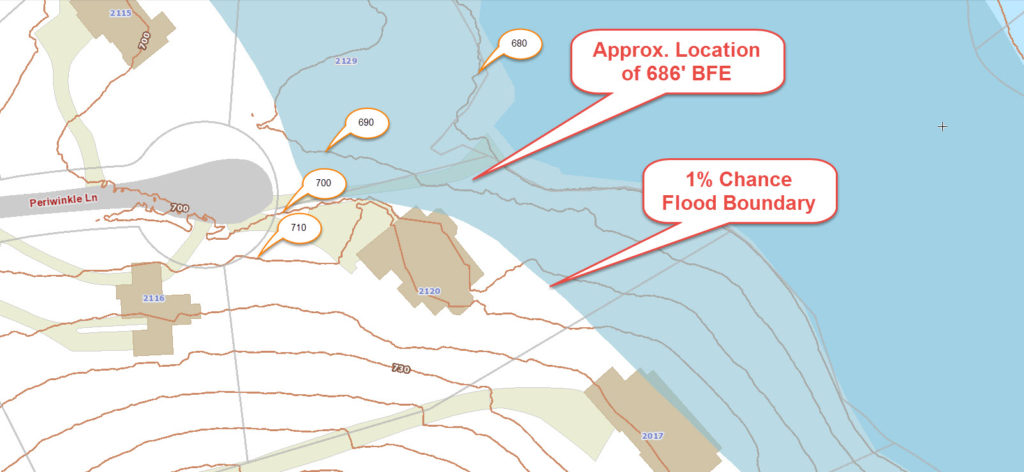
<p>After these are measured, then the <a href="http://sandiegolandsurveying.com/glossary#BFE" target="_blank" rel="noopener">Base Flood Elevation (BFE)</a> is determined from either the Flood Maps (FIRM), the Flood Insurance Study (FIS), or by the local community. The difference in elevation between this BFE and the LAG and/or Lowest Floor will determine the insurance premium rate.</p>
<h2>LOMA Removes Flood Insurance Requirement</h2>
<p>Even if an Elevation Certificate shows that your house is above the Base Flood Elevation at all points, you still have the requirement to obtain flood insurance. Only after the submission and approval of a Letter of Map Amendment (LOMA) can the Flood Map be amended and the Federal mandate for the purchase of flood insurance be removed.<a href="https://madisonlandsurveying.com/flood-damage/difference-fema-elevation-certificate-loma/1282/attachment/gis-with-flood-hazard-zone-overlay" rel="attachment wp-att-1286"><img fetchpriority="high" decoding="async" class="alignright size-large wp-image-1286" src="https://madisonlandsurveying.com/wp-content/uploads/2016/03/GIS-with-Flood-Hazard-Zone-Overlay-1024x472.jpg" alt="GIS with Flood Hazard Zone Overlay" width="940" height="433" srcset="https://sandiegolandsurveying.com/wp-content/uploads/2016/03/GIS-with-Flood-Hazard-Zone-Overlay.jpg 1024w, https://sandiegolandsurveying.com/wp-content/uploads/2016/03/GIS-with-Flood-Hazard-Zone-Overlay-300x138.jpg 300w, https://sandiegolandsurveying.com/wp-content/uploads/2016/03/GIS-with-Flood-Hazard-Zone-Overlay-768x354.jpg 768w, https://sandiegolandsurveying.com/wp-content/uploads/2016/03/GIS-with-Flood-Hazard-Zone-Overlay-500x231.jpg 500w" sizes="(max-width: 940px) 100vw, 940px" /></a></p>
<p>The LOMA process can be done online and typically takes 30 days or less but sometimes a review of the LOMA submission can identify additional information that is needed.</p>
<p>It should be noted that the Elevation Certificate must be completed by a Land Surveyor, Engineer, or an Architect who is authorized by law to certify elevation information, though I don’t know of any Architects that will do these, and not too many Engineers.</p>
<h3>Call San Diego Land Surveying at 256-585-6346 for help with an elevation certificate or LOMA.</h3>The post <a href="https://sandiegolandsurveying.com/difference-fema-elevation-certificate-loma/1282">Difference in FEMA Elevation Certificate and LOMA</a> first appeared on <a href="https://sandiegolandsurveying.com">San Diego Land Surveying</a>.]]></content:encoded>


			</item>
		<item>
		<title>Flooding From Excessive Rain Downstream From Earth Dams</title>
		<link>https://sandiegolandsurveying.com/flooding-excessive-rain-earth-dams/141?utm_source=rss&#038;utm_medium=rss&#038;utm_campaign=flooding-excessive-rain-earth-dams</link>
		
		<dc:creator><![CDATA[SandiegoSurveyor]]></dc:creator>
		<pubDate>Tue, 21 Jul 2015 15:00:11 +0000</pubDate>
				<category><![CDATA[flood damage]]></category>
		<category><![CDATA[flood survey]]></category>
		<category><![CDATA[land surveyor]]></category>
		<category><![CDATA[dam failure]]></category>
		<category><![CDATA[flood]]></category>
		<category><![CDATA[flooding]]></category>
		<guid isPermaLink="false">http://huntsvillelandsurveying.com/?p=141</guid>

					<description><![CDATA[<p>The Daily Republic in South Dakota published an article that talks about an earthen dam that recently failed because of a nine-inch rainfall last 29th of July 2010. The heavy rainfall overwhelmed the dam’s capacity causing it to fail. No <span class="excerpt-dots">&#8230;</span> <a class="more-link" href="https://sandiegolandsurveying.com/flooding-excessive-rain-earth-dams/141"><span class="more-msg">Continue reading &#8594;</span></a></p>
The post <a href="https://sandiegolandsurveying.com/flooding-excessive-rain-earth-dams/141">Flooding From Excessive Rain Downstream From Earth Dams</a> first appeared on <a href="https://sandiegolandsurveying.com">San Diego Land Surveying</a>.]]></description>
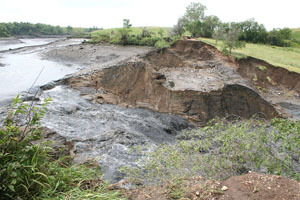
										<content:encoded><![CDATA[<p style="text-align: justify;"><a href="https://madisonlandsurveying.com/wp-content/uploads/2010/01/rose_hill_dam_failure.jpg"><img decoding="async" class="alignleft size-full wp-image-556" title="rose_hill_dam_failure" src="https://madisonlandsurveying.com/wp-content/uploads/2010/01/rose_hill_dam_failure.jpg" alt="" width="300" height="200" /></a>The Daily Republic in South Dakota published an article that talks about an earthen dam that recently failed because of a nine-inch rainfall last 29<sup>th</sup> of July 2010. The heavy rainfall overwhelmed the dam’s capacity causing it to fail.</p>
<p style="text-align: justify;">No injury was reported on the said event. The said damn was built in 1935, as were a number of them during the Work Programs after the Great Depression. In 2007, it was inspected by a Department of Game, Fish and Parks Engineer and he noted that they “were satisfied with the condition of the dam” during that time. It was then again inspected in 2008 and it was said that the dam breach “was caused by an extraordinary natural event and not by any structural weakness in the dam.&#8221; (Photograph by Laura Wehde/The Daily Republic).</span></span></p>
<p style="text-align: justify;"><span style="font-size: 12px;"><span style="font-family: times new roman,times,serif;">Earth dams are almost too numerous to count around the country. In fact, you might just be living near one without you knowing it. A great percentage of these dams were built over 70 years ago and, in many cases, the owners today were not the same ones when they were initially built. For this reason, maintenance and inspection of these dams became less popular.</p>
<blockquote>
<p style="text-align: justify;">FEMA estimates &#8220;there are over 80,000 dams in the United States&#8221;, and that approximately &#8220;one third of these pose a &#8216;high&#8217; or &#8216;significant&#8217; hazard to life and property if failure occurs.&#8221;</p>
</blockquote>
<p style="text-align: justify;">The South Fork dam, the country’s worst dam failure disaster in May of 1889, took over 2200 lives and almost half of which were under 20 years old. This incident happened in the town of Johnstown, PA, thus it was known as the “Johnstown Flood”. A 37-foot high wall of water hit Johnstown, located 9 miles downstream from the dam. It almost destroyed the entire city as 1600 homes and 280 businesses was flushed away.</p>
<p style="text-align: justify;">In March 1928, the St. Francis Dam in California also failed. This caused a legislation to be enacted in and around the said state. This, and other later legislation led to life-saving advance warning when the Baldwin Hills dam near Los Angeles, California failed on December 14, 1963. Because of the advance warning which enabled the evacuation of approximately 16,500, the casualties from dam failures has significantly decreased to 5 individuals </p>
<p style="text-align: justify;">Even though there have been far less loss of lives in the United States from dam failures since the 1970&#8217;s, <!--[if gte vml 1]><v:shapetype
id="_x0000_t75" coordsize="21600,21600" o:spt="75" o:preferrelative="t"
path="m@4@5l@4@11@9@11@9@5xe" filled="f" stroked="f">
<v:stroke joinstyle="miter" />
<v:formulas>
<v:f eqn="if lineDrawn pixelLineWidth 0" />
<v:f eqn="sum @0 1 0" />
<v:f eqn="sum 0 0 @1" />
<v:f eqn="prod @2 1 2" />
<v:f eqn="prod @3 21600 pixelWidth" />
<v:f eqn="prod @3 21600 pixelHeight" />
<v:f eqn="sum @0 0 1" />
<v:f eqn="prod @6 1 2" />
<v:f eqn="prod @7 21600 pixelWidth" />
<v:f eqn="sum @8 21600 0" />
<v:f eqn="prod @7 21600 pixelHeight" />
<v:f eqn="sum @10 21600 0" />
</v:formulas>
<v:path o:extrusionok="f" gradientshapeok="t" o:connecttype="rect" />
<o:lock v:ext="edit" aspectratio="t" />
</v:shapetype><v:shape id="_x0000_i1025" type="#_x0000_t75" alt="Anchor"
style='width:.75pt;height:.75pt'>
<v:imagedata src="file:///C:DOCUME~1RANDOL~1LOCALS~1Tempmsohtml1�1clip_image001.gif" mce_src="file:///C:DOCUME~1RANDOL~1LOCALS~1Tempmsohtml1�1clip_image001.gif"
o:href="http://madisonlandsurveying.com/wp-content/plugins/fckeditor-for-wordpress-plugin/ckeditor/images/spacer.gif?t=99GE" />
</v:shape><![endif]--><!--[if !vml]--><a name="The Association of State Dam Safety Officials"></a><!--[endif]-->reports that…</p>
<blockquote>
<p style="text-align: justify;">there were 132 dam failures and 434 &#8220;incidents&#8221; between January 2005 and January 2009.</p>
</blockquote>
<p style="text-align: justify;">Of course, It should be noted that the failure of the earthen levees near New Orleans, LA during and after Hurricane Katrina are purported to be responsible for killing more than 1000 people.</p>
<p style="text-align: justify;">Failure in The KaLoko Dam on the Island of Kauai, Hawaii in March 2006 has resulted to the death of 7 people. Two years after the said incident, developer James Pfluegar was indicated for manslaughter and reckless endangerment in relation to the dam failure. The incident had caused the country of Kauai and the State of Hawaii to pay out over $9 Million in of <a rel="nofollow" href="http://islandbreath.blogspot.com/2010/02/kaloko-dam-culpability.html" target="_blank">lawsuits</a> after the failure.</p>
<h2 style="text-align: justify;">Cause of Dam Failures</h2>
<p style="text-align: justify;">Heavy rains cause overtopping, which is by far the most common cause of dam failures. Dam spillways and structures are typically not designed for more than a 1-percent chance (aka 100-year) storm event. When a rain event exceeds this, the water starts to travel outside of the control spillway. This causes erosion of the soil on the dam from the excessive amount of water traveling over it. It is also possible for overtopping to occur from smaller rain events because of debris blockage of the outlet structure or spillways or because of settlement of the dam crest.</p>
<p style="text-align: justify;">Foundation defects, including settlement and slope instability, cause about 30% of all dam failures.</p>
<p style="text-align: justify;">Seepage or Piping causes the remaining 20% of the U.S. dam failures. Piping is the internal erosion caused by seepage under and through the dam. This usually happens around structures such as pipes through the dam and spillways. Seepage can also be caused by animals, like beavers, muskrats, groundhogs, and other rodents, burrowing in the dam, by roots of trees growing on the dam, and through cracks in the dam.  All earth dams have seepage resulting from water permeating slowly through the dam and its foundation. But this seepage must be controlled or it will progressively erode soil from the embankment or its foundation, resulting in rapid failure of the dam.></p>
<h2 style="text-align: justify;">What Should You Do To Protect Home?</h2>
<p style="text-align: justify;">Since the failure of a dam causes flood, your best option is to avoid building in a flood zone, unless you elevate and reinforce your home. Have your area surveyed and investigated for dam failure and <a href="http://sandiegolandsurveying.com/tennessee-services/elevation-certificate-flood-survey" target="_blank"><b>flood determination</b></a> so you’ll know if your dream house is safe to be constructed in that certain area.</p>
<p style="text-align: justify;">Do you live downstream from a dam? Is the dam a high-hazard or significant-hazard potential dam? To find out, contact your state or county emergency management agency and/or visit the National Inventory of Dams. There are around 2,228 dams on the National Inventory in Tennessee. And among those, <strong>636 are listed as high or significant hazard potential dams</strong>.</p>
<p style="text-align: justify;">If you live downstream from one of these dams, find out who owns and regulates the dam. This information should also be available from the National Inventory of Dams.></p>
<p style="text-align: justify;">Next, find out if there is an Emergency Action Plan in place. Again, consult your state or county emergency management agency. (<a rel="nofollow" href="https://ema.alabama.gov/" target="_blank">Tennessee Emergency Management Agency</a>)</p>
<p style="text-align: justify;">Strangely enough, Tennessee is the only state in the United States that has not passed dam safety legislation.</p>The post <a href="https://sandiegolandsurveying.com/flooding-excessive-rain-earth-dams/141">Flooding From Excessive Rain Downstream From Earth Dams</a> first appeared on <a href="https://sandiegolandsurveying.com">San Diego Land Surveying</a>.]]></content:encoded>


			</item>
	</channel>
</rss>